
Known only in death: Part 1
An exploration into the treatment of the remains of the poor in Halifax

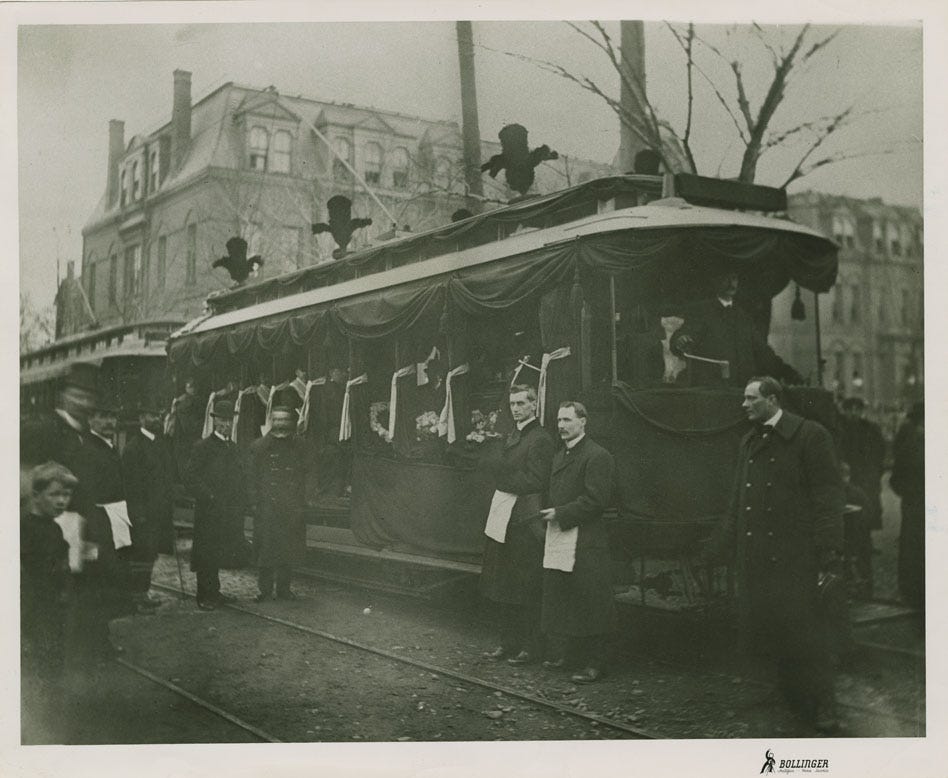
“Death is the problem of the living. Dead people have no problems.” - Norbert Elias (Elias 1985, 3)
“There was a relationship between man’s attitude toward death and his awareness of self, of his degree of existence, or simply of his individuality.” - Philippe Ariès (Ariès 1981, 602)
Ashes to ashes, dust to dust
Death is our collective destination. Everyone will die, and every body returns to the earth. But the lives we live between our time spent as ashes and dust separate us from each other in countless ways. Even after we draw our last breath, how we have lived our lives shapes how we are treated in death. Our posthumous treatment, specifically how our remains are handled and how we are remembered, is shaped by our access to wealth and experiences of poverty. Socioeconomic inequalities not only determine how well we live and die, but they determine our social afterlife. Socioeconomic inequality extends even beyond life into death.
If we’re gone, and if we don’t believe in ghosts, what happens to our bodies and legacies after we die might seem trivial, since we don’t personally have much control over it (aside from various branches of legal systems). I know that I have said many times, as a type of punctuation on a conversation about death that got me just slightly too close to crying, “Just throw me in the woods when I’m gone.” But I know that this is a shield against the anxiety that comes crawling up my spine if I really deeply consider what it means to shuffle off this mortal coil and be unmoored, or enter nonexistence, when we die. Our bodies are our homes. They determine how much and of what quality we experience the world around is. We care for them in life, and we desire for them to be taken care of in death. Beyond preservation of our physical forms, it is a natural extension to consider our legacy, or how our social presence will live on in our community’s consciousness. Most of us don’t want to be remembered as a nasty, unpleasant person, and some of us have desires to leave our worldly belongings in the care of others, such that we can continue to provide safety, comfort, and care after we are gone. Because of these desires, the matter of ensuring that we are treated with dignity after we die is not so trivial after all.
Yet despite our shared consideration of how we are treated after we die–physically and socially–we get “to the end,” as it were, with different means of accomplishing these desires. As much as socioeconomic inequality is a blight on living society, so should it be a concern for the afterlives of people living in poverty.
In this piece, I will consider how possibilities for posthumous dignity–a term I use to refer to the respect someone is afforded after they die–are shaped by socioeconomic inequality. I’m interested in exploring this in the Nova Scotian context, where pauper’s cemeteries sit underneath parking lots less than 100 metres from a cemetery with its own advocacy foundation and where funeral homes take a financial loss to provide full services for people who died while on social assistance and for people who lived in such poverty that they are unknown and unclaimed in death. These two expressions of socioeconomic inequality are related, yet reflective of era-specific societal and governmental practices of poor assistance. Nonetheless I will explore how both pauper’s cemeteries and partially-paid-for funerals for the poor tell us more about the inconsistent nature of our approach to the dead rather than consistently express an era-defining norm around death.
Dignity for the dead
I draw on Immanuel Kant’s definition of dignity to ground my understanding of what is afforded to those who have died. Kant differentiated humans from other beings through our capacity to be moral and rational, and thus have a value beyond what is describable or monetary. Humans have free will and can enact changes in their life to accomplish a goal or as a means to an end; because we have the ability to enact changes and are not simply responsive to stimuli (this is often referred to as being responsive to causality) we must use our free will to do good in the world. Kant’s moral framework requires that we see other humans as having the same ability to enact goodness, which then affords them (and us) dignity. Because humans have free will and have the ability to do good in the world, we have inherent dignity.
Michael Rosen extended Kant’s idea of dignity for living humans to corpses. After we die, our corpse is left as a representative of who and “where” we were, but the corpse itself has no free will or ability to enact changes. Yet we do not treat corpses as objects–at least, when we treat human remains with dignity, they are not treated as objects. Rosen argues that in showing dignity to the dead reaffirms the dignity of the living. Here Elias’ quote at the beginning is key: death is the problem of the living. How we treat each other in death determines how we treat each other in life. The social contract that ensures our corpses are not desecrated , even if we no longer “need” them, keeps society intact.
A poor person’s life and death in Nova Scotia
Early versions of assistance for the poor in Nova Scotia was modeled after the Poor Laws in England, which set standards for who could access assistance and of what type. Two laws were implemented in 1763:
These were an Act to enable the Several Townships within this Province, to Maintain their Poor, and an Act to enable the Inhabitants of Townships to assess themselves for the relief of the Poor, both of which received assent on 26 November 1763. The latter act transferred the burden of supporting the poor from the provincial government to the township officer. (Thomas 1938, 5)
The “maintenance” of a township’s poor classified those facing financial difficulties as a specific group of people who were defined through their neediness. Upon meeting the criteria, the poor would face limited social mobility and would likely remain in the care of the township. When the responsibility for providing financial support, shelter, or work became that of the township, people who sought this assistance became dependent on a particular, and sometimes quite small, community in order to survive. The “devolution” of services to municipalities occurs today, with the outcome being limited services for the poor, and larger governments shielded from the difficulties of providing for individuals with complex, varied needs (Bruch et al. 2018; Banting and McEwen 2018). In these early years of social assistance, when a township was not able to afford the care of “their” poor, impoverished people were often sent outside of the community or were auctioned off as labourers (Katz 1984, 111). Neglect and abuse was common in these relationships (Simpson 2011, 14). Over time, poor houses became established as a form of centralized institutional support offered by larger municipalities. Such was the case for the development of the first poor house in Halifax on Spring Garden Road in the 1750s.
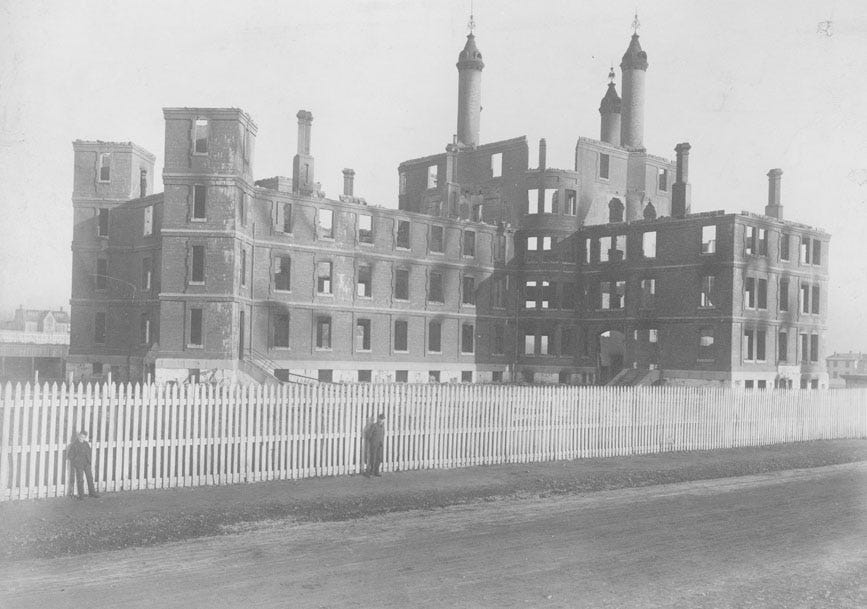
There are no remaining photographs or architectural drawings of the Spring Garden poorhouse. What we know about it comes from descriptions of the conditions written by visiting physicians, politicians, and clergy1. Poverty affected those who did not fit the mold of a productive, hale citizen; single mothers with young children, people facing alcohol addictions, people with intellectual disabilities, people without the physical capabilities to work, and the impoverished elderly were all housed under a single roof and without individual services. The circumstances that brought these people together were determined by social relationships. Because education, work, and family structures were shaped by gender, women would have had less access to education, fewer opportunities for work, and would have been expected to raise children as their primary activity in life; thus single mothers with children would have experienced poverty almost immediately if the father or husband died or abandoned them. People with intellectual disabilities were not understood to have the mental faculties to be regarded as fully human or capable of work as it was structured at the time; poverty was all but a guarantee if their family did not provide support. The elderly, who found themselves unable to continue working but without any means of social safety net to provide for them after their “productive years,” were impoverished by dint of the way individuals were expected to pay their way through life. Spring Garden was host to a wide cross-section of society; there were many paths that led to the poorhouse. Nonetheless, the poorhouse was seen to represent such an insignificant part of Halifax’s history that, to learn its history, we have to piece together peripheral archival records.
What linked these inhabitants was their status of being what Cameroonian historian Achille Mbembe calls “the living dead” (Mbembe 2019, 92) wherein political systems “manufacture an entire crowd of people who specifically live at the edge of life […] people for whom living means continually standing up to death” (Mbembe 2019, 38). Mbembe’s theory of necropolitics focused on how colonial empires inflicted these definitions and life focuses on colonial subjects, but it is relevant here to consider how the lives–and deaths–of the Nova Scotian poor were determined by their treatment by the state in similarly oppressive ways. The social structures that the poorhouse residents navigated, including the shift in provincial support to township support, the dire setting of the poorhouse, and the inescapability of poverty, associated poverty directly with death. To be poor was to live on the edge of death. The death of a pauper did not a rupture social life in the ways that the deaths of heads of households could.
Residents of the Spring Garden poorhouse were buried in a communal grave on the poorhouse property, likely coming face to face with their final resting place as they stepped out the institutions’ front door. Coffin manufacturing was a common form of work offered in poor houses2, including the Spring Garden poorhouse; in fact, “coffins were built in anticipation of an inmate’s death in times of epidemics” (Simpson 2011, 90). The socioeconomic disadvantage of the poorhouse residents put them closer to death. By being buried next to the poorhouse amongst others who sought assistance, their afterlife was limited to that of a pauper3.
Giorgio Agamben’s concept of “bare life” is applicable here. “Bare life” refers to the subjugation of each individual to the state so that their only pathway towards living a meaningful life is through acceptance by the state. Without the possibility of a state-granted “good” life, we have “bare life,” which is devoid of meaning and places us as uniquely vulnerable to violence that others may inflict with impunity. Agamben’s work is used to make sense of the “cruddy” and dehumanizing settings of long term care homes; the overrepresentation of Black and Brown people in COVID exposure; the lives of Indigenous people living in communities with limited access to clean water, appropriate housing, and economic opportunities. Considering the experiences of those living in Halifax’s pre-20th century poorhouses through Agamben’s work allows us to see the “bare death” that comes from a “bare life.”
The sole circumstance that levelled the field between the poor and the rich in terms of their experience of death was an epidemic. Waves of typhus, cholera, and tuberculosis swept over the province and took thousands of residents to mass graves in Fort Massey Cemetery and underneath the Little Dutch Church and St Paul’s Church. As a cart circled the town each morning during the cholera outbreak of 1834, the victims of the epidemic, both rich and poor, were buried together with haste in order to prevent the spread of disease (Fingard et al. 1999, 122). During times of uncertainty and emergencies, there was not time to differentiate based on class. Given time, however, those class relations bubble to the surface. Victims of epidemics are memorialized in cemeteries around Halifax; victims of poverty receive no such memorialization.
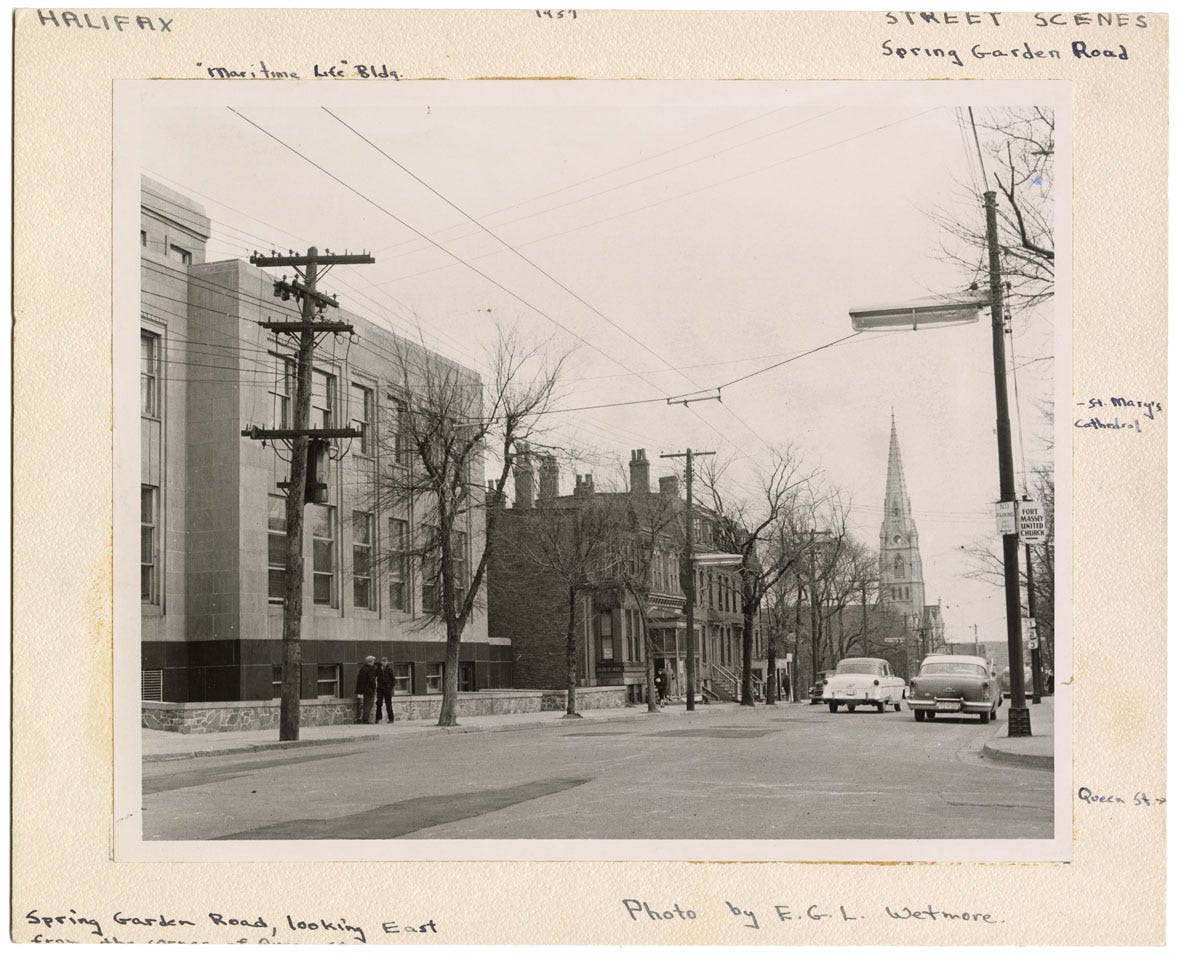
After it was closed, sold to a private citizen, and torn down in 1869, the Spring Garden Poor House ceased to exist, but all the dead who had been buried in its century-long operation remained in the ground. A number of proposals for what should be built in its place were put forward; eventually, the Spring Garden Road Memorial Public Library was built in 1951. It was the first public library in Halifax as well as the first post-War public structure built in the city. The library has since closed, and there are now new proposals for what should be done with the structure and the property. Alongside a statue of Winston Churchill walking headlong into a stiff breeze, large trees, a paved pathway, and grassy areas provide a somewhat calm ambiance to the lot, under which nearly 4,500 people are buried.
What is most striking is that if one arrives at the former poorhouse and library lot walking east along Spring Garden, and continues another 30 seconds this way until they arrive at Barrington Street, they will be in front of one of Halifax’s most well-known cemeteries: the Old Burying Ground. Almost 12,000 people are buried here, their tombstones protected from winter weather by handmade miniature tents. The Old Burying Ground Foundation states that the graves hold information that is useful for understanding the Halifax’s past, information that might help us understood our modern Halifax (The Old Burying Ground Foundation, n.d.). What would tombstones and records of those who passed through the Poor House, just up the hill, have revealed? Not only are substantial details of the lives of the people who depended on the shelter and work provided by the poorhouse lost to history, but so are their names and their relations. This is the impact of socioeconomic inequality: the history of poor people is not counted as a history at all. There is no plaque on the green expanse on the grounds of the former Poor House or in front of the former library. Unrecorded, unnamed, and if it remains uncovered, the history of people other than those who could afford tombstones–and thus the details of their lives–become all that is worth mentioning.


References (across all 3 parts):
Alternatives, Canadian Centre for Policy. 2024. “Press Release: Nova Scotia Saw Alarming Increase in Poverty and Food Insecurity—Some of the Highest in the Country.” CCPA, April 29. https://www.policyalternatives.ca/news-research/press-release-nova-scotia-saw-alarming-increase-in-poverty-and-food-insecurity-some-of-the-highest-in-the-country/.
Ariès, Philippe. 1981. The Hour of Our Death. 1st American ed. Knopf.
Banting, Keith, and Nicola McEwen. 2018. “Inequality, Redistribution and Decentralization in Canada and the United Kingdom.” In Constitutional Politics and the Territorial Question in Canada and the United Kingdom: Federalism and Devolution Compared, edited by Michael Keating and Guy Laforest. Springer International Publishing. https://doi.org/10.1007/978-3-319-58074-6_5.
Bruch, Sarah K., Marcia K. Meyers, and Janet C. Gornick. 2018. “The Consequences of Decentralization: Inequality in Safety Net Provision in the Post–Welfare Reform Era.” Social Service Review 92 (1): 3–35. https://doi.org/10.1086/696132.
Elias, Norbert. 1985. The Loneliness of the Dying. Continuum.
Fingard, Judith, Janet Vey Guildford, and David Sutherland. 1999. Halifax: The First 250 Years. Formac Pub. Co.
Government of Canada, Statistics Canada. 2024. “The Daily — Canadian Income Survey, 2022.” April 26. https://www150.statcan.gc.ca/n1/daily-quotidien/240426/dq240426a-eng.htm.
Henderson, Jennifer. 2026. “Province Silent on Fate of N.S. Poverty Reduction Credit in 2026-27 Budget.” Halifax Examiner, March 23. https://www.halifaxexaminer.ca/province-house-2/province-silent-on-fate-of-n-s-poverty-reduction-credit-in-2026-27-budget/.
Katz, Michael B. 1984. “Poorhouses and the Origins of the Public Old Age Home.” The Milbank Memorial Fund Quarterly. Health and Society 62 (1): 110–40. https://doi.org/10.2307/3349894.
Mbembe, Achille. 2019. Necropolitics. Translated by Steve Corcoran. Theory in Forms. Duke University Press.
Pugh, Allison J. 2024. The Last Human Job: The Work of Connecting in a Disconnected World. 1st ed. University Press. https://doi.org/10.1515/9780691240824.
Schönecker, D., & Wood, A. W. (2015). Immanuel Kant’s Groundwork for the metaphysics of morals: A commentary (1st ed.). Harvard University Press. https://doi.org/10.4159/harvard.9780674736214
Simpson, Cynthia. 2011. “The Treatment of Halifax’s Poor House Dead During the Nineteeth and Twentieth Centuries.” Master’s thesis, Saint Mary’s University. https://www.smu.ca/webfiles/Simpsonburials.pdf.
Stevenson, Lisa. 2014. Life Beside Itself: Imagining Care in the Canadian Arctic. University of California Press.
Rosen, M. (2012). Dignity: Its history and meaning. Harvard University Press.
The Old Burying Groundation Foundation. n.d. “Foundation.” Accessed April 17, 2026. https://oldburyingground.ca/foundation/.
Thomas, C. H. 1938. “The Administration of the Poor Law in Nova Scotia, 1749-1937.” Master’s thesis, Dalhousie University.
Image credits (all from Nova Scotia Archives)
“Transportation & Communication: Street Cars: Funeral Car for William A. Prindiville, corner Morris and South Park Streets, copy 3”, Nova Scotia Archives Photographic Collection
“State Funeral procession for Sir John Thompson, Prime Minister of Canada, photographed on Barrington Street, Halifax, Nova Scotia”, 3 January 1895, Notman Studio Nova Scotia Archives 1983-310 number 1395 / negative: N-1376 N-2436 N-8968
“Sir John Thompson, Funeral Car, Died December 12, 1894, Buried January 3, 1895”, Notman Studio Nova Scotia Archives 1983-310 number 1411 / negative: N-1375
““Leaving St. Mary’s Cathedral” and “Proceeding along Spring Garden Rd.”, Funeral of Premier Angus L. Macdonald, 19 April 1954”, FULL CAPTION ON ARCHIVES: “The body of Premier Angus L. Macdonald lay in state in the Red Room of Province House,15-19 April 1954. Thousands filed by the casket to pay their last respects, and thousands lined city streets to view the funeral cortège. On Easter Monday, servicemen pulled the gun carriage up George Street, along Barrington and up Spring Garden Road to the Basilica. After the Requiem Mass at St. Mary’s, the late premier was interred in Gate of Heaven Cemetery, Lower Sackville.”, Photographer: Royal Canadian Navy, National Defence Nos. 30274, 30290, 19 April 1954, Nova Scotia Archives Photo Drawer - People - Macdonald, Angus L. - Funeral
“Reconstruction workmen, Alex[ander] McKaye [sic] School, Halifax, N.S.” Alexander McKay School served as temporary living quarters for workmen until April 1918, Photographer: W.G. MacLaughlan, Donald Fraser Nova Scotia Archives 1980-340
See: Allan Marble’s Physicians, Pestilence, and the Poor: A History of Medicine and Social Conditions in Nova Scotia, in 1800-1867, 2006; Marguerite H. L. Grant’s “Historical Sketches of Hospitals and Alms Houses in Halifax, Nova Scotia, 1749 to 1859” published in Volume 17, Issues 4, 5, and 8 in The Nova Scotia Medical Bulletin, published in 1938; and Cynthia Simpson’s Masters thesis on the poorhouse dead in Nova Scotia, to whom a great debt is owed for the historical research on poorhouses referenced here.
As per Simpson, who dug through the archives to find evidence of this work: “The inmates of the poor house manufactured coffins for the use of the town, the Cholera Hospital, the Richmond and Melville Island Hospitals, Dartmouth Hospital, Waterloo Hospital (NSARM RG25, series C, vol. 5,”Record Book, 1829-1860”), the Bank Head Hospital (NSARM MG100, vol. 156, #30-30a., reel #15198), as well as the City Home (HRM Archives 102-96.1, “Charities, 1895-1912.”)” (Simpson 2011, 47).
A haunting aspect that accompanied the heavy presence of death for poorhouse inhabitants was that remains were sometimes not buried at all but rather used to teach medical students at Dalhousie University. Inquests conducted in 1875 into Dr. Lindsay, house surgeon at the Spring Garden Poor House, centred on rumours of removal of bodies from the institution for the purposes of medical education. While the reason for the inquest is unclear, Simpson notes that “in an age where the opportunity to enhance medical knowledge was paramount, poor house inmates of the mid-nineteenth century and onward may have simply served as prime teaching instruments to physicians” (Simpson 2011, 88).